Gartner's latest buyer survey landed on a number that should reframe how every service provider thinks about growth: 67% of B2B buyers now prefer a completely rep-free buying experience, up six points in a single year. Push further, and it gets starker. 70% prefer a fully digital, self-service purchase with no human in the loop.
Many providers view these numbers as a threat to customer relationships. However, customers are indicating they want to purchase at any time, without waiting for quotes, callbacks, or ticket resolutions. They are willing to manage administrative tasks themselves. The key consideration is whether your business enables this.
The economic effects are clear.
Each order received by email or phone incurs payroll costs. Staff must read, verify, enter, and confirm each order. Across changes, upgrades, renewals, cancellations, and numerous small transactions, this results in significant staffing dedicated to re-entering decisions customers have already made.
Self-service eliminates these costs and removes growth limitations. Providers with customer portals can expand their customer base without increasing order desk staff. Service availability is no longer limited by staffing or time zones. The store operates continuously in all markets, with consistent costs regardless of order volume.
The same logic applies to buyers, which explains their preference for self-service. Delays, such as waiting two business days to add licenses, do not match expectations for good service.
In spite of these advantages, many self-service portals remain underutilized.
A common oversight in self-service discussions is the risk of purchase regret. The same Gartner research found that unassisted digital purchases are more likely to result in dissatisfaction. While digital buying is efficient, it can also cause costly mistakes.
Anyone who has run IT procurement has the story. The subscription someone spun up and forgot. The upgrade nobody budgeted. During our own customer research for the feature this article ends with, one example came up that makes the point better than any statistic: a user selected the wrong high-cost product and committed their company to very sizable first year spend. One click.
The underlying issue is not demand or technology, but trust. Finance and IT leaders could not monitor purchasing authority or prevent costly errors, leading them to restrict access. Self-service fails not due to lack of interest, but due to insufficient governance.
Governance should be integrated into the purchasing process.
Most companies handle this by adding email approval chains, which reintroduce the costs self-service was designed to eliminate. Requests are delayed in inboxes, approvals lack audit trails, and processes stall when key individuals are unavailable.
A sustainable solution is to embed customer controls directly into the purchasing process. This requires a set of essential, reliable capabilities:
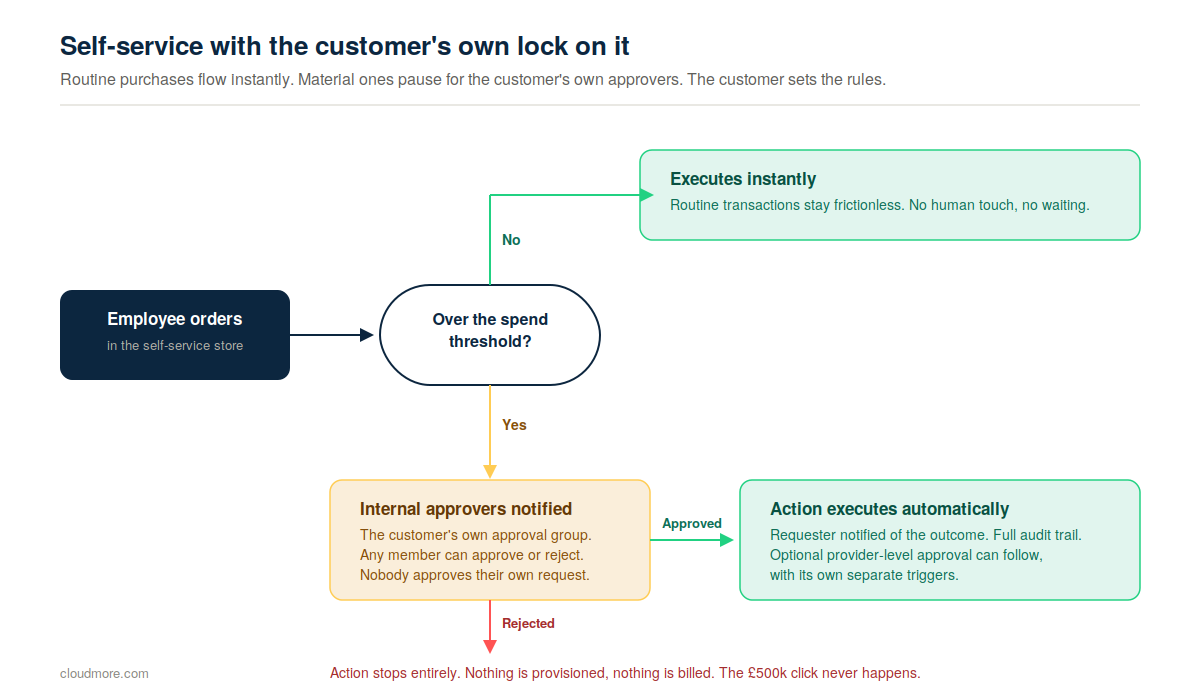
Thresholds allow governance to scale with risk. Low-value transactions, such as a £30 monthly add-on, can proceed immediately, while high-value commitments, like a £500,000 annual contract, require review. Customer-defined spend thresholds ensure routine transactions remain efficient, while significant ones receive appropriate oversight.
Approvals should be managed by groups rather than individuals. Any authorized group member can act, preventing delays caused by the absence of a single approver.
Separation of duties should be standard. No individual should approve their own request, which is consistent with key audit requirements.
Both requesters and approvers should have visibility into the process. Requesters can track their requests, approvers receive timely notifications, and all actions are recorded for transparency.
Implementing these measures allows customer leadership to maintain both openness and control. They can establish rules once and enable their teams to manage purchases directly. Providers benefit from increased transactions, broader account reach, and an order desk that does not require additional resources as volume grows.
Recent Product Update
For this reason, we developed the Organization Internal Approval Process, now available in Cloudmore.
Customers can now configure their internal approval workflows within the platform, maintaining full control independent of provider approval rules. They determine which actions trigger approvals, such as new subscriptions, quantity changes, or cancellations. In addition, spend thresholds, define who can initiate requests, and assign approval groups can be configured. Approvers receive email notifications and any authorized member can act. No individual can approve their own request. When both approval layers are configured, internal approvals are completed before reaching the provider.
The feature is disabled by default. Each customer works with their provider on the best way to enable and configure the end to end approvals, ensuring governance remains with those responsible for the budget.
For providers, the impact is clear. Enterprise customers with strict procurement and audit requirements, previously hesitant about self-service, can now confidently adopt it. The solution empowers them with control over both access and approvals.
Self-service is not about eliminating personal interaction, but about streamlining transactions while maintaining customer control. Providers who balance accessibility with robust governance will achieve the greatest growth.
Sources and further reading
- Gartner sales survey: 67% of B2B buyers prefer a rep-free experience, March 2026
- Gartner, The B2B buying journey: buyer preference for digital self-service, and the purchase-regret finding
- Organization Internal Approval Process, Cloudmore Knowledge Base
Survey figures are from Gartner, based on research published in 2026. Product behavior reflects the Cloudmore Knowledge Base at the time of writing.
Share this

The Real Reason Customer Self-Service is Essential to the CSP Program

Is Your Margin Protected From Microsoft's Price Rise?