Microsoft 365 Copilot Cowork reached general availability worldwide on 16 June 2026. It's a genuinely significant release: an agentic layer inside Copilot that plans and executes multi-step work, grounded in Microsoft's new Work IQ context engine, rather than just answering a single prompt. For partners, it's also the first Copilot capability billed on consumption rather than a flat seat price, and that change carries a sharp edge for anyone managing customers through CSP.Here is the part worth your attention before 1 July: if you manage a customer's Microsoft 365 tenant through CSP, their own Azure subscription cannot pay for Cowork usage. Billing must come through a CSP-channel Azure plan that you, the partner, provision. Customers cannot fix this themselves, no matter how many Azure subscriptions already sit in their tenant. Until you've set up that channel, Cowork stops working for them at general availability.
This is also a genuine opportunity. CSP partners who get ahead of this become the only ones who can unlock Cowork for their customers, and usage-based AI billing is a new, recurring revenue and advisory motion that didn't exist in the CSP channel a month ago.
What Cowork actually is
Copilot Cowork is not a bigger version of Copilot Chat. Chat answers a prompt. Cowork takes an outcome a user describes, plans the steps, reasons across emails, meetings, files, and chats through Work IQ, and returns a finished deliverable: a document, a dashboard, a board, or a set of sent communications. During its three-month Frontier preview, more than half of the Fortune 500 used it, including Accenture, Avanade, and Capital Group.
Cowork sits on top of the existing Microsoft 365 Copilot license, not instead of it. A user still needs the standard Copilot seat at $30 per user per month for Chat and the in-app experience. Cowork's task execution is billed separately, on usage, in a unit Microsoft calls a Copilot Credit.
How the billing actually works
A Copilot Credit costs $0.01 under pay-as-you-go pricing. What a task costs depends on four inputs: which model it uses, how much organizational context it pulls in, how many tools it calls, and how long it runs. Microsoft groups tasks into three rough tiers from Frontier preview usage:
Typical Cowork task costs
Indicative pay-as-you-go costs based on task complexity.
| Task type | Typical cost | What it looks like |
|---|---|---|
| Light | $1–$3 | Single-step, limited reasoning, one output or fewer |
| Medium | $4–$7 | Multiple sources, structured reasoning, two or more outputs |
| Heavy | $7+ | Broad aggregation, deep reasoning, many outputs |
Note: Actual task cost depends on model use, organizational context, tool calls, and task duration.
Customers can also commit to a Copilot Credit Pre-Purchase Plan (P3) for a discount off the pay-as-you-go rate. Prepaid credits are consumed first, and anything beyond that rolls automatically to pay-as-you-go, so a task in progress never stops because the prepaid block ran out.
None of this is automatic or silent. Cowork is disabled by default in every tenant. A fixed Copilot seat cost remains at its current level; usage costs only begin once an admin actively enables billing and sets a spending policy. Admins can then set hard caps and alerts at the tenant, group, or individual level in the Microsoft 365 admin center's Cost Management dashboard.
Where the CSP-specific wall sits
This is the detail that matters most for partners, and it is not well publicized. Usage-based billing needs a charge basis, and Microsoft requires that it be an Azure subscription. For a directly-billed customer, their own Azure subscription works fine.
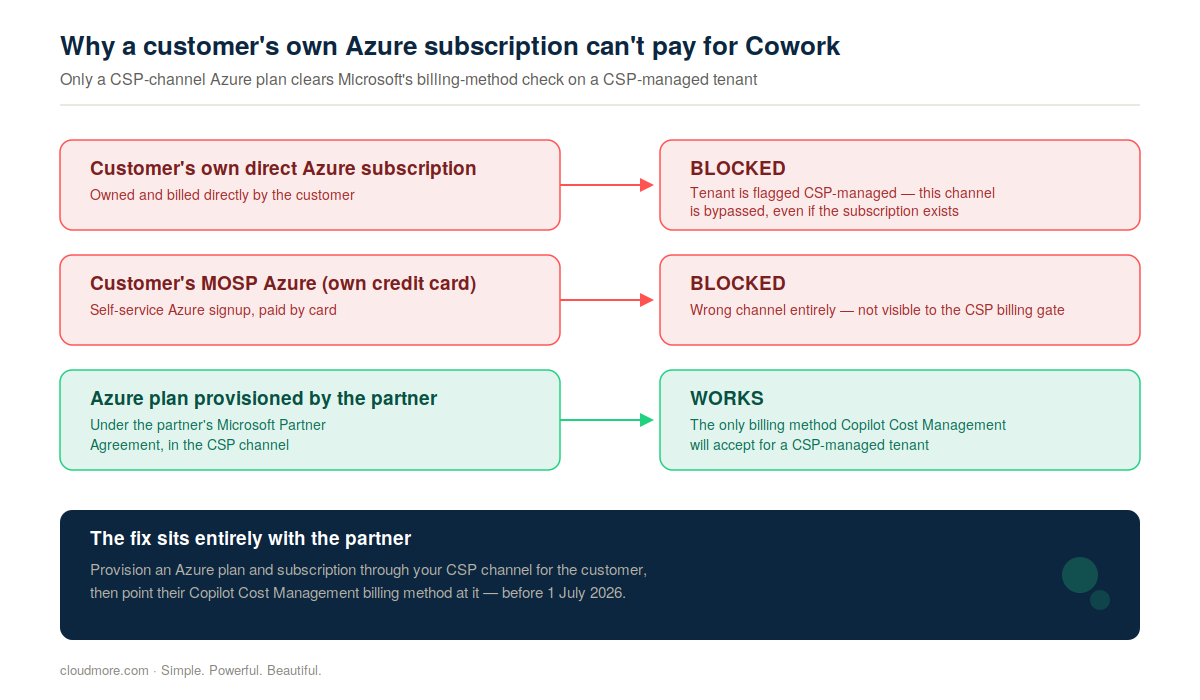
For a customer whose tenant is managed through CSP, it does not. Microsoft flags CSP-managed tenants, and the billing-method picker in Copilot Cost Management will only accept an Azure plan and subscription provisioned by the partner under the Microsoft Partner Agreement — the same channel a partner already uses to sell Azure consumption. A customer's own direct Microsoft Customer Agreement subscription, even if it already exists in the tenant, is bypassed. There is no setting the customer can change on their end to fix this. The fix sits entirely with whoever holds the CSP relationship.
In practice, that means: if you manage a customer through CSP and they want to use Cowork, you need to provision an Azure plan and subscription through your CSP channel for that customer, then point their Copilot Cost Management billing method to it. Until that's done, Cowork will not bill, and once the general availability grace period ends, it will not run.
The deadline
Tenants that had at least one user active in Cowork's Frontier program between 30 March and 16 June 2026 get a grace period: no billing until 1 July 2026. Every other tenant has been billed from general availability on 16 June. Either way, 1 July is the point after which a CSP-managed tenant without a billing channel set up loses the ability to use Cowork at all, not just to bill for it.
If any of your customers ran a Frontier pilot, they are the most urgent to check first; the grace period gives a false sense of safety right up until it ends.
Why is this worth doing properly, not just patching
This isn't a one-off fix. Work IQ, the context engine behind Cowork, went generally available the same day and uses the identical billing model: Copilot Credits, the same CSP-channel Azure requirement, and the same Cost Management dashboard. Microsoft has said more agents and services will move to usage-based billing over time. The Azure plan you provision now for Cowork is very likely the same plumbing the next consumption-based Copilot service will need.
This also reframes what's at stake. Until now, Microsoft 365 billing through CSP has mostly been about predictable per-seat subscriptions, the kind of thing a price rule and a renewal report handle well. Usage-based billing introduces something genuinely new to the channel: variable monthly spend, customer cost anxiety, and a real advisory role for the partner in setting sensible caps and reading consumption trends. Partners who treat this as a one-time technical fix will miss the larger shift; partners who build a repeatable process around it have a new, durable service line.
What to do before 1 July
1. Identify which CSP-managed customers are using, or asking about, Cowork. Start with anyone who had access to the Frontier program between 30 March and 16 June — their grace period ends on 1 July, and it is easy to assume that the lack of a current bill means there is nothing to do.
2. Provision a CSP-channel Azure plan and subscription for each one. This is the only billing method Copilot Cost Management will accept for a CSP-managed tenant.
3. Point Copilot Cost Management at that subscription and set a spending policy before usage ramps. A safe starting default: discovery off, pay-as-you-go connected, a small pilot group, a monthly cap, and alerts at 80–90% of that cap.
4. Use Microsoft's Cowork Cost Calculator to model expected spend before setting limits, rather than guessing and adjusting after a surprise invoice.
5. Build this into your customer conversations as a service, not just a fix. Helping a customer understand and control variable AI spend is a genuinely new value-add in the CSP relationship, and an opening to talk about Cowork adoption more broadly while you're already in the account.
Where to go for the details
- Usage-Based Billing and Cost Management for Copilot Credits — Microsoft Learn, official overview
- Managing AI experiences enabled by usage-based billing — Microsoft Learn, setup, and admin details
- Copilot Cowork is now generally available — official Microsoft 365 Blog announcement
Figures and billing mechanics sourced from Microsoft's official Learn documentation and the Microsoft 365 Blog GA announcement, current as of late June 2026. Always verify the current pricing and policies in the Partner Center and the Microsoft 365 admin center before advising customers.
Share this

Demystifying Microsoft's Coterminosity for MSPs in the New Commerce Experience

Microsoft New Commerce Experience: A Complete Guide