MSP Sales Is Broken. AI Didn't Break It. AI Just Made It Obvious.
There is a version of this story where technology is the villain. Automation arrives, strips away the human touch, and leaves MSP sales teams redundant and scrambling.
That version is wrong. And believing it is actually the more dangerous mistake. Read on...
The truth is more complicated. AI, self-service, and smarter buyers are not destroying MSP sales. They are exposing which activities were never really sales in the first place.
The informational edge is gone
For years, much of what counted as "selling" inside the channel was really something else: interpretation. Translating licensing complexity. Explaining vendor changes. Quoting on behalf of customers who couldn't quote themselves. Navigating NCE mechanics that only partners understood.
That information gap was real, and it created genuine value. But it was always borrowed time.
Gartner's 2026 research shows that 67% of B2B buyers now prefer a rep-free buying experience, and 45% used AI during a recent purchase. 6sense data from 2025 shows buyers complete up to two-thirds of their journey, including selecting a preferred vendor, before speaking to a single salesperson.
These aren't buyers educated by a competitor's sales team. They are buyers who educated themselves. The intermediary function, the person who explained what things cost and what they meant, is being displaced not by a smarter salesperson, but by a better-informed buyer.
For MSPs that built their commercial motion around being that interpreter, this is not a productivity problem. It is a structural one.
Self-service doesn't just improve experience. It removes touchpoints.
Self-service is almost always framed as a CX improvement. Faster provisioning. Fewer tickets. Better portals. And it is all of those things.
But there is a commercial consequence that rarely gets discussed directly.
Every interaction removed by self-service once justified a commercial resource. Purchasing a seat, upgrading a licence, renewing a contract, making a configuration change: each of these required a human. That human often sat in a sales or account management function.
Forrester has projected that more than half of large B2B transactions exceeding $1 million will increasingly run through digital self-serve channels. MSP industry data confirms that automation and platform-led customer experience are now top strategic investments across the sector.
The implication is not subtle. If the activity that filled a commercial role's calendar is being automated away, the question is not whether headcount will change. It is whether the remaining activity justifies the same structure.
AI is exposing what was never really selling
HubSpot's 2025 State of Sales research found that 84% of sales professionals say AI saves them time. Salesforce found that reps spend around 70% of their time on non-selling tasks: administrative work, internal coordination, routine communication.
Put those two findings together and something uncomfortable emerges.
If AI is most effective at automating repeatable, process-driven work, and 70% of what sales teams do falls into that category, then the question is not whether AI will change sales. The question is why so much of what was labelled "sales" was actually process administration.
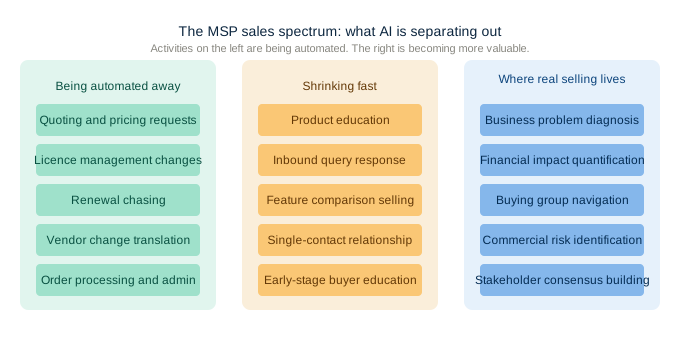
This matters in the MSP context because the activities in the left and middle columns are exactly what many channel sales roles were built around. Not because MSP leaders made bad decisions, but because those activities genuinely needed doing. The problem is that the market has stopped rewarding them at the same rate, while the cost of carrying them has not changed.
The champion trap: why the buying group problem is getting worse
Here is where the conventional response, more pipeline, more outreach, more SDR activity, tends to make things worse rather than better.
Gartner research from 2025 shows that B2B buying groups now range from five to sixteen stakeholders across as many as four functions. 74% of those groups experience what Gartner calls "unhealthy conflict" during the decision process. Groups that reach consensus are 2.5 times more likely to report a high-quality purchase outcome.
6sense adds a finding that should stop MSP sales leaders cold: between 40% and 60% of buying journeys that end without a purchase fail not because the vendor was wrong for the job, but because the buying group could not reach internal alignment. The deal was lost to inertia, not a competitor.
Most MSP sales teams are still structured around the primary-stakeholder model. Find the right person, build the relationship, move them through a process. That model works when one decision-maker can sign. It fails increasingly often when the real decision sits across a technical lead, a finance director, a procurement team, and an executive sponsor who has not yet engaged.
The irony is that buyers now arrive later and better informed, but without internal consensus sorted. The informational job that sellers used to do has been replaced by a different and harder one: helping fragmented buying groups make a decision and defend it internally.
Very few MSP sales teams are trained, measured, or compensated to do that work.
The commoditisation problem underneath it all
None of this happens in isolation. It is playing out against an MSP market where price pressure and service commoditization are the top long-term concerns cited by industry leaders, and where 71% of MSPs identify customer acquisition as their single biggest challenge.
MSP Global's 2025 research found that upselling existing customers is now the number one sales priority across the sector, ahead of new logo acquisition. That is a rational response to a difficult market. But it also means many commercial teams are focused on mining a book of business rather than building the new commercial capabilities the market is demanding.
When margins compress and differentiation is harder to establish, the cost of commercial inefficiency becomes more visible. Missed renewals that used to disappear into broad margins now show up clearly. Pricing inconsistencies accumulated through years of manual management become measurable revenue leakage. Legacy agreements running on outdated commercial terms represent real cost, not just administrative untidiness.
The business case for modernizing the commercial stack, not just the delivery stack, has never been stronger. Or more urgent.
What the modern MSP sales role actually looks like
The conclusion here is not that sales headcount should fall. It is that the definition of what a commercial role should do has changed, and most organizations have not caught up.
The future MSP seller is not differentiated by how quickly they respond to a quote request or how well they know the licensing matrix. They are differentiated by how clearly they can diagnose a customer's operational and financial position, quantify where value is being lost, build a case for change that holds across multiple stakeholders, and navigate a buying group through the internal friction that kills decisions.
That is a materially different job description. It requires commercial literacy, not just product fluency. It requires data, not just relationships. It requires the ability to run a conversation that spans finance, operations, and IT, not just the IT department.
And it requires a platform capable of surfacing the information that makes that kind of selling possible. When billing, subscription, usage, and margin data are consolidated and visible, the question a seller walks into a conversation with changes from "what can I sell you?" to "here is where you are losing money, and here is what we can do about it."
That shift, from reactive to diagnostic, is where the real commercial opportunity in managed services sits.
The question MSP leaders should be asking
If a significant portion of your revenue still depends on people manually quoting, correcting, chasing, and translating, is that a sales model? Or is it an operational dependency wearing a sales title?
Because if it is the latter, the exposure is not coming. It is already here. Competitors who have automated the transactional layer are not spending that time on more quotes. They are spending it on the commercial work that creates and protects margin.
The organizations that recognize this transition early can redesign around it: separate commerce infrastructure from value creation, align commercial roles to where genuine skill is required, and build the data visibility that makes high-quality selling possible.
Those that do not will continue to scale a model that becomes less efficient, and less competitive, over time.
Cloudmore exists at the intersection of this transition. When subscription management, billing, and commercial data work together in a single platform, the manual intermediation layer disappears, and the people who used to run it are free to do the work that actually builds long-term customer value.
See how Cloudmore removes the commercial friction from your MSP operation.
Share this

Governance Matters for MSPs: To Build Trust, Efficiency, & Compliance

Why MSPs Must Transition to Self-Service: A Strategic Imperative