This question was once simple to answer.
Previously, platform selection focused on reliable provisioning, accurate invoicing, and Partner Center synchronization. User-friendly portals and multi-currency billing provided partners with a competitive advantage.
Today, the focus has shifted.
The Microsoft CSP program has evolved more in the past 18 months than in the previous five years combined. New revenue thresholds have been introduced, the renewal model has been completely rebuilt, and significant numbers of Enterprise Agreement customers are migrating into the CSP channel. Copilot and Agent 365 are reshaping enterprise customer expectations, and a global pricing update coming in July 2026 presents both commercial risks and short-term opportunities, depending on how well prepared your business is.
A platform that was previously ideal may no longer be sufficient. This article outlines recent changes, their impacts, and what is required for 2026.
What has changed in the program?
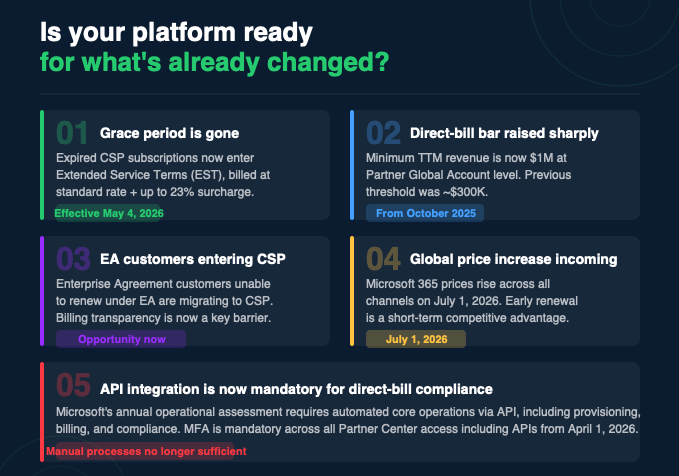
First, the grace period has ended.
On May 4, 2026, Microsoft ended the grace period during which expired CSP subscriptions remained active without charge. This free period has been replaced with Extended Service Terms (EST). Under EST, once a CSP subscription expires, it continues as a paid service for a defined period. During this time, rather than remaining free, partners or customers are billed for continued use. EST ensures that, after expiration, ongoing access is no longer complimentary and incurs charges in accordance with Microsoft's terms.
Now, if a CSP subscription that qualifies expires without being renewed or canceled, it does not enter a complimentary holding period. Instead, it is automatically moved into Extended Service Terms (EST). During EST, the subscription is billed monthly at the standard rate plus a 3% surcharge for SKUs available on monthly billing. If the SKU doesn't support monthly billing, the surcharge is 23%. EST replaces the previous unpaid grace period, so customers retain service but are now billed for continued access.
Partners should be aware of two critical considerations.
The first is promotional pricing, starting April 1, 2026, when a subscription expires in the Cloud Solution Provider program, customers who move to an extended service term will not have promotions from the previous subscription carried over, which may result in a higher monthly price due to the loss of promotional rates and any added surcharges. According to a Microsoft report, if your customer agreements do not specifically allow you to pass on extended service term (EST) costs, your business will need to cover those expenses.
The second consideration is retrospective exposure. Subscriptions with auto-renew turned off were automatically set to go into EST by Microsoft starting April 1, 2026. Partners who did not audit these settings may already have customers in paid EST periods they did not anticipate.
As a result, renewal management must be proactive, automated, and auditable. Platforms without clear end dates, EST indicators, or early renewal triggers now present significant risks.
Additionally, direct-bill requirements have shifted dramatically.
From October 2025, Microsoft raised the bar for direct-bill CSP authorization more substantially than at any point in the program’s history.
The minimum trailing twelve-month CSP billed revenue for direct-bill partners is now $1 million at the Partner Global Account level. The previous threshold was approximately $300,000. Partners also need at least one active Solutions Partner designation, must complete an annual operational assessment covering billing, provisioning, compliance, customer support, and security, maintain an active Microsoft support plan, and have MFA enforced across all Partner Center access, including APIs, which became mandatory from April 1, 2026.
API integration is now becoming a must-have. Microsoft requires direct-bill CSPs to automate core operations, and your infrastructure is included in the operational assessment. Manual or incomplete API processes do not meet these standards.
Partners with trailing twelve-month revenue between $300,000 and $1 million must either scale rapidly to meet the new threshold, transition to indirect operations and adjust margins, or risk losing direct-bill status at their next annual review.
Meanwhile, EA migration is accelerating, creating new opportunities.
In late 2024 and early 2025, some Enterprise Agreement customers became ineligible to renew under the EA framework. According to Gartner, organizations wanting direct Microsoft relationships are advised to move to MCA-E, while those seeking partners should consider CSP. With EA customers reassessing, partners offering transparency, governance, and reliable service can secure these accounts. Otherwise, competitors are likely to secure these accounts.
While some customers remain eligible for EA renewals due to shifting timelines, the trend is clear: developing enterprise-scale CSP capabilities now is more advantageous than waiting.
Finally, a global pricing update takes effect in July 2026.
Microsoft has confirmed a price increase across commercial Microsoft 365 suites, effective July 1, 2026, which will apply to new and renewing customers in all channels.
For CSP partners, this presents a short-term advantage. Customers who renew before July 1 can secure current pricing, providing a strong incentive to initiate renewal discussions. Microsoft data shows that timely renewals recover more business than late renewals.
To address this, your platform should identify customers due for renewal in the next 60 to 90 days, streamline outreach, and facilitate seamless billing transitions. Manual management now increases the risk of missed renewals.
What to look for in a CSP Platform
Bi-directional Partner Center synchronization
The foundation remains unchanged: accurate, real-time synchronization between your platform and Microsoft Partner Center is essential. Provisioning, license changes, renewals, and billing require seamless bi-directional integration. Any gaps now create risks, including revenue leakage in the post-EST environment. EST and renewal management that is genuinely automated
Given these changes, your platform must do more than display end dates. It should highlight EST exposure, enable bulk review of auto-renew settings, and trigger renewals at the appropriate time. With a seven-day NCE cancellation window, no grace period, and new pricing, there is no margin for manual error.
If your platform still relies on manual Partner Center checks and spreadsheet cross-references, this represents a risk rather than an effective workflow.
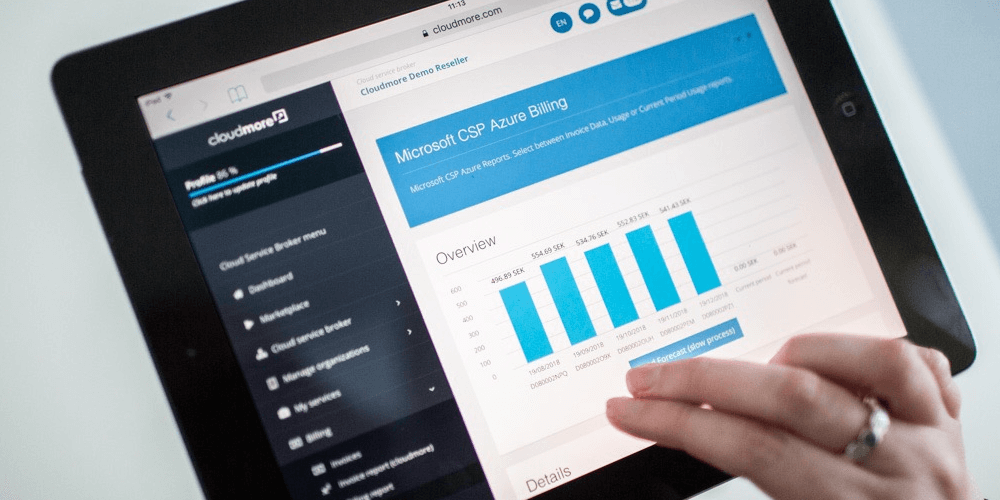
Azure billing transparency
The most consistent objection in EA migration conversations is the lack of visibility into billing. Enterprise customers moving from EA had clear cost center attribution, departmental breakdowns, and predictable billing views that their finance teams had built processes around. CSP billing has historically been harder to navigate.
Partners who address this gap by offering Azure cost management, detailed reconciliation, and cost center attribution aligned with EA standards remove significant barriers to enterprise migration. This is more than a feature; it is a key differentiator for conversion and retention.
Enterprise self-service with control
Most CSP platforms offer a portal, but lasting value comes from enabling managed service delivery, not just providing invoice access.
This distinction is important. Effective self-service enables customers to view subscriptions, track usage and spending, manage seats within defined parameters, and submit support requests independently. This elevates your service from a helpdesk to a platform and supports a managed services relationship instead of a transactional reseller model.
Your platform must manage customer permissions. Self-service without governance introduces risk, while configurable controls demonstrate thoughtful design.
Tech stack integration
A standalone CSP platform is only a tool, not a complete solution. Integration with PSA, CRM, and ERP systems transforms operations from manual to scalable. Microsoft Community Hub reports that partners should move customers with commercial legacy subscriptions to new commerce before Microsoft-led migrations begin on renewal dates. Managing non-Microsoft cloud products within the same system remains essential. Partners who deliver a unified experience across clouds gain a commercial advantage as the market consolidates. Separate portals increase the likelihood that customers will switch providers.
Platform Vendor Vision
This question is increasingly common in platform evaluations, highlighting the need to clarify what is being asked.
For smaller MSPs, the decision is operational: does the platform provision reliably, bill accurately, synchronize with Partner Center, and keep pace with program changes? If so, this is typically sufficient.
For larger MSPs, group businesses, or partners managing enterprise customers, the question is different. It is not only about current platform capabilities, but also whether the vendor understands market direction, has the necessary architecture, and has demonstrated consistent execution. This is a matter of vendor confidence, not just a feature checklist.
This distinction is important because platform migrations are costly and disruptive. Selecting the wrong vendor today results in lost features, wasted time, and additional expenses. It can require months of re-implementation when your enterprise customers have the highest expectations.
So what does the right direction of travel look like? Large MSPs and group businesses evaluating platforms should look for evidence in two key areas
The first is whether the vendor shares the same vision for the future. Enterprise customers are transitioning from EA to CSP. AI agents are now a reality in licensing and governance. Analytics across diverse customer bases, cohort-level intelligence, and configurable platform behavior by customer segment are now standard expectations.
The second is whether the platform architecture can support future needs. There is a significant difference between a platform built on modern, extensible infrastructure and a legacy billing engine with added features. The former can evolve, while the latter often accumulates technical debt that limits future capabilities. Enterprise customers will quickly test these limits, as their requirements for billing transparency, governance, and integration are more demanding than most platforms were originally designed to handle.
These are the questions that serious buyers are starting to ask. They are reasonable questions that deserve direct answers.
Cloudmore
Partners who will grow their CSP business profitably over the next two to three years are those who automate routine tasks, provide billing transparency to attract and retain enterprise customers, and select a platform vendor aligned with the market's future direction.
Cloudmore is designed for direct-bill CSP partners who want to operate a scalable, automated Microsoft business without increasing operational overhead as they grow.
It provides bi-directional Partner Center synchronization, automated EST and renewal management, Azure cost transparency, a white-label customer portal, and full API integration for direct-bill compliance, all within a platform designed for the requirements of the 2026 CSP program.
If you are re-evaluating your platform or preparing for direct-bill status, please contact us

Share this
Microsoft Perpetual License Price Management & Billing with Cloudmore

Cloudmore Supports Revenue Growth Using Azure Plan and Microsoft NCE