


A Microsoft Cloud Solution Provider (CSP) can use AI to build a customer portal in an afternoon. An enterprise customer will judge it when someone changes a subscription and finance asks who approved it, which price applied, and where the change was recorded. Those questions come up in billing disputes, security reviews, and audits. That’s the work partners need to account for when deciding whether to build or buy.
AI has made software cheaper to build
In McKinsey's 2026 State of AI survey of 1,719 leaders, 32% said their organization had decided against buying at least one software product or feature because it could build it in-house with AI coding tools. Retool surveyed 817 builders and found that 35% had already replaced at least one SaaS tool with something they built, and 78% expected to build more in 2026.
Microsoft's chief executive started much of this conversation. In December 2024, Satya Nadella said the idea that business applications exist is "probably where they'll all collapse" in the agent era. In the first week of February 2026, investors acted on that idea. Forrester counted more than $1 trillion wiped off software stocks in seven days.
We use AI across our own work at Cloudmore, from analysis to first drafts of posts like this one. For CSP partners deciding where to use AI, the type of software matters. Retool's figures are about internal tools: admin screens, workflow automations, dashboards for the team. And 60% of the people it surveyed had built software outside IT's oversight in the past year.
There are two kinds of AI work
AI on your own processes. You own the risk. If the tool gets something wrong, the worst case is usually a bad number in your own report, and you can fix it the same day. Go fast here.
Software in front of your customer. Your customer inherits it. Their security team has to assess it, their auditors need evidence, and their users depend on it.
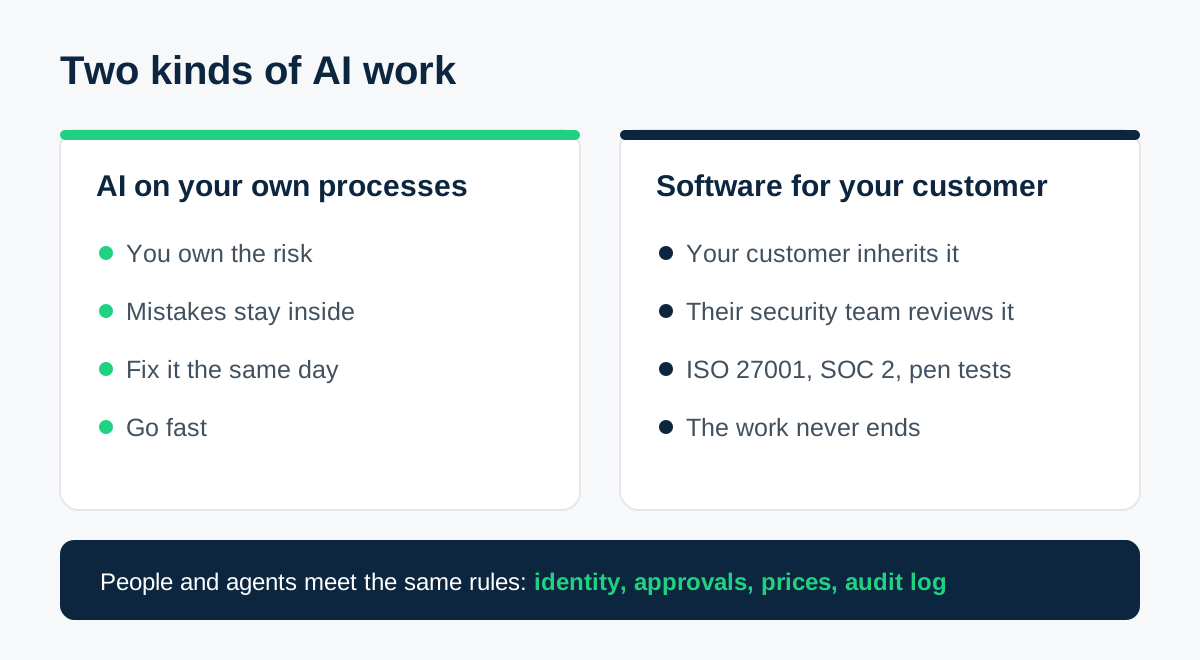
Two kinds of AI work: internal processes where you own the risk, and customer-facing software where your customer inherits it
The evidence on the second kind is sobering:
- One study favored specialist vendors. MIT's NANDA study of enterprise AI found that tools bought from specialist vendors reached their goals about two-thirds of the time. Internal builds succeeded only a third as often.
- AI-written code still fails security tests. Veracode tested more than 100 models on 80 coding tasks and found security flaws in 45% of the results.
- Even the inventor sets limits. Andrej Karpathy, who coined "vibe coding", said it was fine for "throwaway weekend projects". A portal for an enterprise customer is the opposite of a weekend project.
- Your supplier is your customer's risk. Verizon's 2025 Data Breach Investigations Report found that third parties were involved in 30% of breaches, double the year before.
What an enterprise customer actually checks
Ask anyone who has been onboarded as a supplier to an enterprise recently. The security assessment is still long and detailed, even when the software is quick to build. In ISC2's 2025 survey of more than 1,000 security professionals, 77% named compliance with standards such as ISO 27001, NIST or SOC 2 as their top requirement for suppliers. Next came independent audits and attestations (71%) and multi-factor authentication and secure access (62%). Most organizations reassess suppliers on a schedule, usually at renewal or once a year.
In practice, the questions look like this:
| They ask | What it takes |
|---|---|
| ISO 27001 or SOC 2? | An independent audit, then yearly surveillance audits or a fresh report every period |
| Can we use our own sign-in? | Single sign-on the customer can enforce, plus multi-factor authentication |
| Who can see, order and approve? | Roles, approval steps and limits, set per customer |
| Can we see what happened? | An audit log of every change and sign-in, which the customer can export |
| Who tested it? | A penetration test by an outside firm, usually yearly |
| Where is our data? | A named region, a list of sub-processors and a data processing agreement |
| What if something goes wrong? | An incident process, a notification deadline and someone on call |
A typical shape, not a full questionnaire. Many run to hundreds of questions, plus documents as evidence.
None of that is a one-off. Certificates expire. Auditors come back. Identity settings drift as customers change their sign-in setup. Security teams add questions every year. This is the dull, permanent work of being trusted, and it lands on whoever owns the software. AI can write the first version of a portal. It doesn't turn up for the surveillance audit.
When an AI agent places the order
In a headless setup, agents can perform tasks through APIs without opening the portal. Salesforce launched Headless 360 in 2026 under the line "No browser required", and its agents inherit the permissions and sharing rules customers have already set up. Box's Aaron Levie imagines a hundred times more agents in the enterprise. His view is that the system that "traffic-cops those agents becomes more valuable".
Customers are already moving that way. A 2026 Gartner survey found customers about three times more likely to use their own AI tools than a company's chatbot to sort out a service issue. And they increasingly use those tools to take action, not just to find answers.
Suppose a customer’s agent requests a subscription change. The platform needs to verify who the agent is acting for, what it can change, which price applies, and whether someone needs to approve it. It also needs to record the request and the outcome. The API has to enforce the same rules as the portal. People still need a place to review the change and make decisions, which is one reason we rebuilt the interface in Cloudmore 5.0.
Self-service still needs a human behind it
Gartner’s 2026 buyer research found that 69% of B2B buyers turn to sales reps to verify what AI told them. Self-service works best when customers can reach someone who can check the answer and explain what to do next.
A customer can change a subscription on their own schedule. If a renewal quote shows an unexpected price, the CSP partner can check the terms, explain the difference, and resolve any pricing exception.
Questions to ask of any platform, including one you build
- Does an agent using the API meet the same rules as a person using the interface?
- Who keeps the security documentation current when a customer reassesses the portal?
- Who fixes it at 2 a.m., and who handles next year's audit?
If you're building, those questions are your backlog. If you're buying, they're your shortlist.
Where Cloudmore stands
Cloudmore is certified to ISO/IEC 27001, with annual surveillance audits. Customers can sign in with their own identity provider over SAML and enforce single sign-on only. Multi-factor authentication is built in, and IP allowlisting covers both the interface and the API. Customers can search and export the audit log or use the API to bring it into their own security tools. An outside firm tests the platform every year, and customer data stays in its region, in Europe or the United States.
Cloudmore 5.0 runs on the same API as the interface it replaces, so integrations keep working. For end customers, more is planned for the first half of 2027, including API access, further interface improvements and more self-service insight and control. Treat that timing as indicative.
Weighing build or buy for a customer portal? Ask your Cloudmore account manager for our security documentation, and run it against the questions above. Then run your own build against them too.
Frequently asked questions
Is SaaS dead because of AI agents?
No, but it is changing. AI has made software cheaper to build, and companies are building more of their own internal tools. Software that holds the rules, the records and the security controls tends to become more important as agents multiply, because every agent still needs permissions, approvals and an audit trail.
Should a CSP partner build its own customer portal with AI?
For internal tools, often yes. For a portal enterprise customers will use, weigh the ongoing cost of ownership: security assessments, ISO 27001 or SOC 2 evidence, penetration tests, single sign-on, audit logs and support. Those don't end at launch.
What does headless SaaS mean?
Headless software exposes what it can do through APIs and agent tools, so people and AI agents can use it without opening its screens. The rules, permissions and records stay in the platform underneath.
Sources and further reading
- The state of AI in 2026, McKinsey: 32% decided against buying software they could build
- The build vs. buy shift, Retool, 2026: 35% replaced a SaaS tool, 78% building more, 60% building outside IT
- SaaS as we know it is dead, Forrester: the February 2026 sell-off
- Microsoft CEO: AI agents will transform SaaS, CX Today: Satya Nadella on the BG2 podcast
- MIT report on generative AI pilots, Fortune: bought versus built success rates
- 2025 GenAI Code Security Report, Veracode
- Andrej Karpathy on vibe coding, via Simon Willison
- 2025 Data Breach Investigations Report, Verizon: third-party involvement at 30%
- 2025 Supply Chain Risk Survey, ISC2: what organizations require of suppliers
- Introducing Salesforce Headless 360, Salesforce
- The case for context graphs, Foundation Capital: Aaron Levie on systems of record
- B2B buyers validate AI insights with reps, Gartner, May 2026
- Customers prefer their own AI tools to company chatbots, Gartner, July 2026
- Related reading: Most customers now prefer minimal direct interaction with providers and Cloudmore 5.0: Less Complexity. More Productivity.
Figures taken from the sources above as of 26 November 2026. Cloudmore capabilities as described in our current security documentation. Roadmap items and timings are indicative and may change.
Share this

The Real Reason Customer Self-Service is Essential to the CSP Program
Migrating Customers from an Indirect to Direct CSP Agreement
