Mergers and acquisitions in the managed services space are accelerating, yet the post-deal reality frequently falls short of the strategic vision. Direct CSP operations (spanning billing, provisioning, governance, and reporting) frequently remain fragmented across acquired entities for months or even years after closing.
This fragmentation creates margin leakage, customer disputes, and compliance risks that compound over time. According to Global PMI Partners' 2025 M&A Success Survey, nearly 70% of integrations fail to meet their original synergy targets, with IT and operational consolidation ranking among the top challenges. For Direct CSPs, the stakes are even higher: Microsoft CSP operations management complexity multiplies when two partner tenants, two billing systems, and two governance models must become one. This guide walks you through the complete process for integrating the post-acquisition Microsoft CSP operating model. You'll learn how to unify governance frameworks, standardize billing and provisioning, consolidate Partner Center synchronization, and establish consistent reporting across countries and business units.
Key Takeaways: How to Integrate Direct CSP Operations After Acquisitions
- Post-acquisition CSP integration requires a structured 12-month roadmap that covers governance, billing, provisioning, and reporting to prevent revenue leakage.
- Billing harmonization should occur before tenant consolidation to preserve commercial leverage and margin protection during negotiations.
- Forming a unified governance framework across acquired entities reduces compliance risk and streamlines audit processes. This guarantees smoother transitions and greater accountability throughout the integration period.
- Cloudmore allows Direct CSPs to standardize billing reconciliation and pricing governance across multiple tenants and countries.
- Country-specific rollout planning addresses regulatory, currency, and local market requirements without disrupting customer service. By taking a customized approach, you can maintain trust while meeting local compliance needs.
Why Post-Acquisition CSP Integration Fails Without a Clear Operating Model
The typical post-acquisition approach treats Microsoft CSP operations as a downstream IT task. Billing, provisioning, and governance are assigned to operational teams who inherit two separate systems, two pricing models, and two customer bases. This framing misses the commercial reality: CSP operations directly impact revenue recognition, margin protection, and customer confidence. When integration lacks a unified operating model, problems multiply. Billing discrepancies arise because the acquired and acquiring entities calculate proration differently. Renewal windows fall out of sync. Pricing governance breaks down when one entity uses fixed margins while the other uses percentage discounts off Microsoft's recommended price. The financial impact is significant. Errors in pricing, calculation mistakes, and missed renewals can cumulatively wipe out CSP margins across an entire quarter. This is why the operating model must be defined before operational coordination begins, not after.
What Is a Microsoft CSP Operating Model?
A Microsoft CSP operating model defines how your organization manages the end-to-end lifecycle of CSP services. This includes subscription provisioning, license management, pricing governance, billing reconciliation, renewal handling, and customer self-service. The model also covers Partner Center synchronization, API integrations with PSA and ERP systems, and reporting structures. For a single-entity Direct CSP, the operating model develops organically over time. After an acquisition, you're managing two models simultaneously, each with different workflows, pricing rules, billing cycles, and customer expectations. Integration means converging these models into a single, standardized approach that scales across both entities. The operating model needs to address five core domains: governance and compliance, billing and revenue management, provisioning and subscription lifecycle, customer self-service, and reporting and analytics. Focusing on these pillars delivers a resilient, scalable base for future growth.
How to Structure the Post-Acquisition Integration Timeline
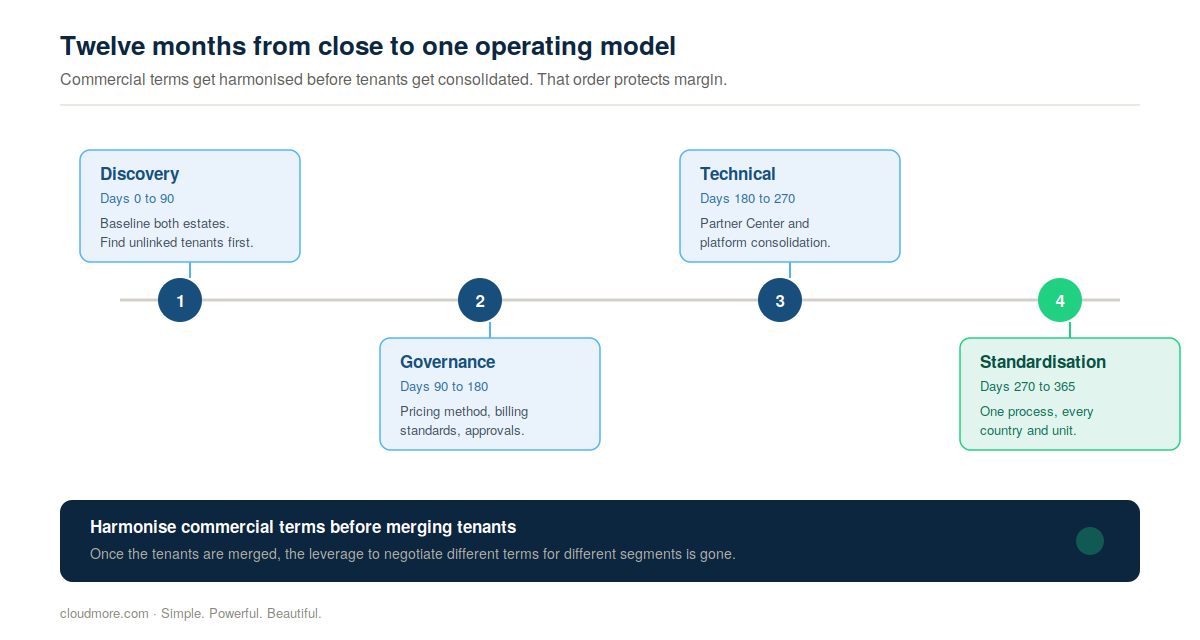
A disciplined integration follows a four-phase timeline over 12 months. Each phase has separate objectives that build toward a unified operating model.
Phase 1: Discovery and Baseline (Days 0–90)
The first ninety days establish a complete picture of both CSP estates. Document every tenant, every customer agreement, every pricing rule, and every billing cycle across both entities. The baseline reveals where the gaps and overlaps sit.
Start with tenant discovery because it is the fastest way to find money already leaking. Cloudmore reads the tenants registered to you in Partner Center and raises an alert showing how many are not yet linked to an organization. That matters more than it sounds: an unlinked tenant does not appear in billing reports, and no billing data is generated for it. After an acquisition, when an unfamiliar estate arrives in bulk, unlinked tenants are the most common cause of customers being served but not billed.
Also, reconcile deployed licenses against purchased entitlements for both estates and identify any true-up exposure that will land on the combined entity's Microsoft relationship. Document every billing frequency, proration method, and margin calculation used.
Record which commercial model each customer sits under while you are doing this. Acquisitions frequently combine two different ones, and knowing on day thirty which customers transact through a distributor and which are direct is what stops that from becoming a surprise in month seven.
This phase includes mapping customer relationships. Some customers may hold agreements with both entities. Others may have been promised different service levels or pricing. Those overlaps need to be resolved before billing harmonization starts.
Phase 2: Governance Framework and Commercial Harmonization (Days 90–180)
The second phase focuses on establishing the rules that will govern the combined entity. This is where you define the unified pricing methodology, billing frequency standards, and governance policies. Setting these standards early reduces operational confusion and provides consistency across the new organization. Commercial harmonization should occur before tenant consolidation. Once tenants are merged, you lose leverage points that are essential during pricing negotiations. Maintain flexibility in your commercial position until governance frameworks are fully established. Key decisions during this phase include: Will you apply fixed margins or percentage markups? Will you standardize on monthly or annual billing? How will multi-currency pricing work across countries? What approval workflows will govern subscription changes?
Phase 3: Technical Integration and Platform Consolidation (Days 180–270)
With governance frameworks defined, technical integration can begin. This phase covers Partner Center consolidation, API integration with unified back-office systems, and migration of customer tenants to the standardized platform. Partner Center consolidation calls for careful sequencing. You must update the affiliate inclusion schedules to reflect the post-close legal entity structure. If both entities operated separate EAs alongside CSP, evaluate whether to maintain hybrid agreements or consolidate to a single commercial relationship. Platform consolidation means selecting a single CSP management platform to handle billing, provisioning, and customer self-service for the combined entity. Running parallel systems indefinitely increases operating costs and risk for both your business and your clients.
Phase 4: Operational Standardization and Country Rollout (Days 270–365)
The final phase standardizes processes across all countries and business units. At this point, you're no longer integrating two entities; you're operating as a single unified CSP business with consistent billing, pricing, and governance across the board. Country rollout requires attention to local regulatory requirements, currency handling, and tax treatment. Each market may have specific invoicing requirements that your unified platform must accommodate. Being proactive here ensures compliance and minimizes disruption for customers across all locations. Training is critical during this phase. Account managers, support teams, and finance staff need to understand the new operating model. Customer-facing teams must be prepared to communicate changes to billing formats or portal access clearly, ensuring customers feel supported throughout the transition.
How to Establish Unified Governance Across Acquired CSP Operations
Governance defines who can do what within your CSP operations. After an acquisition, you often inherit conflicting permission structures, approval workflows, and audit processes. Unifying governance requires explicit decisions about control versus flexibility.
Role-Based Access and Delegated Administration
Define standardized roles for the combined entity: who can provision new subscriptions, who can modify pricing, who can approve large orders, and who can access customer billing data. Map existing roles from both entities to these standards. Delegated administration through GDAP (Granular Delegated Admin Privileges) must be reviewed for all customer tenants. Ensure the surviving partner entity has appropriate permissions, and that legacy permissions from the acquired entity are revoked or transferred.
Approval Workflows and Commercial Controls
Standardize approval thresholds for subscription changes, pricing modifications, and customer-specific discounts. One entity may have allowed account managers to grant discounts freely, while the other may have required finance approval for any deviation from the list price. The combined model needs clear rules to avoid confusion and maintain consistency. Cloudmore's platform supports configurable approval workflows that enforce commercial controls without slowing down legitimate business activities. Account managers can operate with autonomy within defined guardrails, while finance maintains visibility into decisions that impact margins.
Audit Trails and Compliance Documentation
Every subscription change, pricing modification, and billing adjustment should be logged with complete traceability. This audit trail is critical during Microsoft compliance reviews and internal financial audits. Post-acquisition, audit requirements will intensify. Microsoft compliance functions historically increase attention on merged entities in the first 12 to 18 months. Having a complete, consolidated audit trail across both legacy estates significantly reduces compliance risk.
How to Harmonize Billing and Revenue Management After an Acquisition
Billing harmonization is where margin protection meets operational reality. Two entities with different billing systems, different billing cycles, and different pricing models must converge on a single approach. If done poorly, this creates customer confusion and revenue leakage. If done well, it becomes a source of competitive advantage.
Standardizing Billing Models and Frequencies
Document the billing models used by other entities. One may bill monthly in arrears with proration, while the other may bill annually in advance. Hybrid models that combine subscription and consumption charges add further complexity. Decide on the standard billing model for the combined entity. Consider customer expectations, cash flow implications, and operational simplicity. Monthly billing offers flexibility but increases administrative workload. Annual billing improves cash flow predictability but reduces flexibility for customer changes.
Price Management and Margin Protection
Price management determines how you set customer-facing prices relative to Microsoft's list prices. Options include fixed margins (a percentage added to cost), percentage discounts off MSRP, or customer-specific negotiating. Cloudmore's price and offer management enables persistent pricing rules that withstand Microsoft's frequent price list updates. When Microsoft changes its underlying costs, your margin percentages automatically remain intact. This prevents the revenue leakage that occurs when price changes require manual intervention.
Billing Reconciliation and Revenue Assurance
Every billing line must reconcile against Microsoft's invoice to you. Discrepancies between what you're charged and what you bill customers represent direct margin erosion. After an acquisition, the reconciliation complexity multiplies. You're reconciling billing across two Partner Center tenants (or more), two sets of customer pricing rules, and potentially two different billing platforms. Cloudmore provides 100% billing reconciliation by automatically matching every customer transaction against Microsoft's billing data.
How to Consolidate Microsoft Partner Center Operations
Partner Center is the operational hub for Direct CSP billing, subscription management, and customer administration. Post-acquisition, you may have multiple Partner Center tenants that need consolidation or coordination.
Tenant Consolidation Strategy
Decide whether to consolidate into a single Partner Center tenant, maintain multiple tenants with federation, or run a multi-tenant architecture with Multi-Geo for international operations. The decision shapes your operational model for years to come. Single-tenant consolidation simplifies management but requires customer migrations. Multi-tenant federation maintains operational separation but adds coordination overhead. Microsoft's regional authorization rules may constrain your options; certain customer tenants cannot be moved across regions.
Customer Relationship and Reseller Agreement Migration
For customers moving between Partner Center tenants, new reseller relationships must be established. This requires customer consent through the Microsoft reseller agreement process. Plan customer communications carefully. Customers need to understand why they are being asked to accept a new relationship. Subscription transfer processes differ for legacy and New Commerce Experience (NCE) subscriptions. NCE subscriptions can be transferred between partners via the Partner Center transfer functionality. Legacy subscriptions require reprovisioning under the new tenant.
When The Acquired Entity Is an Indirect Reseller
One scenario deserves separate planning, because it is common and it behaves differently from everything else in this phase. A direct bill CSP acquires a business that transacts as an indirect reseller under a distributor, so the combined entity is running two commercial models at once, not just two systems.
Consolidating that is a migration in its own right rather than a step inside tenant consolidation. The customer tenants stay exactly where they are, but the transacting CSP partner changes from the distributor's tenant to your direct bill tenant, which means reseller relationships have to be established with your Partner Center tenant and subscriptions transferred across, with Microsoft 365, legacy and Azure subscriptions each following their own path.
Two things about it affect your integration plan specifically. It puts a third party into the approval chain, because the distributor acts as source partner on every transfer request and has its own internal process for approving them, so timelines are not fully within your control. And the direct bill authorization you already hold is a prerequisite gate for the whole exercise, so it needs confirming for the regions the acquired customers sit in before any of this is scheduled. Both argue for identifying the affected customers during discovery in phase 1, even though the transfers themselves belong in phase 3.
We have covered the mechanics in full separately, including the transfer routes for each subscription type and the pitfalls partners hit along the way, in our guide to migrating customers from an indirect to a direct CSP agreement.
API Integration and Automation
Cloudmore's Microsoft 365 CSP Direct integration synchronizes bidirectionally with Partner Center. Changes made in Cloudmore automatically propagate to Partner Center. Changes made directly in Partner Center sync back to Cloudmore. This two-way sync ensures data consistency without requiring double entry. With over 130 API endpoints, Cloudmore integrates with your broader technology stack, including ERP systems, PSA platforms, and accounting software. Post-acquisition, you are likely consolidating back-office systems alongside CSP operations. An API-first architecture makes this integration practical.
How to Standardize Provisioning and Subscription Management
Provisioning workflows determine how quickly and accurately new subscriptions are delivered to customers. After an acquisition, you inherit different provisioning approaches that must converge.
Subscription Lifecycle Standardization
Document the subscription lifecycle for both entities: how subscriptions are created, how quantity changes are handled, how renewals are managed, and how cancellations are processed. Identify where workflows differ and decide on a standard approach. Subscription management through a unified platform ensures consistency regardless of which legacy entity the customer originally belonged to. Account managers follow the same workflows for every customer.
Renewal Management and Coterminosity
Renewal dates often scatter across the calendar after an acquisition. Different customers renew in different months, making revenue forecasting difficult and creating an irregular workload for operations teams. Coterminosity (aligning renewal dates) simplifies management but requires customer agreement to modify contracts. Evaluate which customers would benefit from aligned renewals, and plan negotiations accordingly.
Customer Self-Service Enablement
Self-service reduces operational burden while improving customer experience. After an acquisition, customers from both entities need access to a unified self-service portal. Cloudmore's white-label customer portal can be branded for your organization while providing consistent functionality across all customers. Customers manage subscriptions, view billing, and request changes without waiting for account manager intervention.
How to Build Unified Reporting Across Countries and Business Units
Reporting enables visibility into the health of your combined CSP operations. After an acquisition, you need reports that span both legacy estates and provide consistent metrics.
Financial Reporting and Margin Visibility
Build financial reports that show cost, sales, and margin at multiple levels: total portfolio, individual customer, individual subscription, and billing in detail. This visibility enables proactive margin management rather than reactive discovery. Cloudmore's billing analytics show month-over-month cost and sales trends, enabling you to track margin direction and make strategic pricing decisions. These reports are available at the global level and drill down to individual customers.
Operational Reporting and SLA Compliance
Operational reports track provisioning times, subscription change processing, and support ticket resolution. After an acquisition, establish baseline metrics and track improvement as integration proceeds.
Executive Dashboards and Board Reporting
Post-acquisition, leadership wants visibility into integration progress and combined business performance. Build dashboards that show unified metrics without requiring manual consolidation of data from multiple systems.
How to Plan Country-Specific Rollouts for Multi-National Operations
Many acquisitions bring international operations into scope. A Direct CSP acquiring another Direct CSP may gain presence in new countries, each with different regulatory requirements, currencies, and customer expectations.
Regulatory and Tax Considerations
Each country has specific invoicing requirements, tax treatment rules, and data residency regulations. Your unified platform must accommodate these variations while maintaining standardized workflows. Work with local finance and legal teams to document country-specific requirements before rollout. Build these requirements into the platform configuration rather than treating them as exceptions that require manual handling.
Multi-Currency Pricing and Billing
Cloudmore supports multi-currency price management, enabling you to set prices in local currencies while preserving consistent margin calculations. Microsoft's price lists are available in multiple currencies; your platform should leverage this to minimize foreign exchange exposure for customers.
Phased Country Rollout Planning
Don't attempt to integrate all countries simultaneously. Prioritize based on revenue materiality, operational complexity, and local team readiness. Successful integration in one country yields learnings that accelerate subsequent rollouts.
Common Pitfalls in Post-Acquisition CSP Integration
Learning from common mistakes helps you avoid repeating them. These patterns frequently appear in CSP integrations that fail to deliver the expected value.
Treating Integration as an IT Project Rather Than a Commercial Initiative
CSP integration affects revenue, margin, and customer relationships. IT teams can execute technical tasks, but commercial decisions require leadership from finance and operations. Run integration as a CFO-sponsored initiative, not a CIO-delegated task.
Consolidating Tenants Before Harmonizing Commercial Terms
Tenant consolidation removes leverage points for commercial negotiation. Once you've merged Partner Center tenants, your ability to negotiate different terms for different customer segments diminishes. Harmonize commercial terms first, then consolidate.
Underestimating Customer Communication Requirements
Customers notice when their billing format changes, when their portal access changes, or when their account manager changes. Active communication builds trust. Reactive communication after problems emerge erodes confidence.
Maintaining Parallel Systems Indefinitely
Every day you run parallel billing systems, you double the operational overhead and create opportunities for discrepancies. Set aggressive timelines for platform consolidation and hold teams accountable.
In Conclusion: Building a Unified CSP Operating Model After Acquisitions
Post-acquisition CSP integration succeeds when treated as a strategic commercial initiative rather than an operational cleanup task. The 12-month integration timeline structures the work: establish baselines, define governance, execute technical integration, and standardize operations across countries. Cloudmore's platform supports Direct CSPs through this journey by providing billing accuracy, pricing governance, and renewal discipline in a single operating model. The platform's deep integration capabilities connect CSP operations to your broader technology stack while maintaining real-time synchronization with Microsoft Partner Center. The organizations that capture full value from acquisitions are those that move deliberately through each integration phase and need to resist the temptation to delay difficult decisions and maintain focus on the commercial outcomes that justify the deal in the first place.
FAQs About How to Integrate Direct CSP Operations After Acquisitions
How long does post-acquisition CSP integration typically take?
A thorough integration takes 12 months, structured in four phases: discovery (90 days), governance and commercial harmonization (90 days), technical integration (90 days), and operational standardization (90 days). Rushing this timeline risks revenue leakage and customer disruption.
Should we consolidate Partner Center tenants after an acquisition?
Tenant consolidation offers operational simplicity but reduces commercial flexibility. Cloudmore recommends completing commercial harmonization before consolidating tenants. This preserves leverage during pricing negotiations and prevents locking in unfavorable terms.
How does Cloudmore help with post-acquisition billing integration?
Cloudmore's billing platform reconciles billing across multiple Partner Center tenants. It automatically applies unified pricing rules. The platform provides 100% billing reconciliation by matching every customer transaction against Microsoft's invoices, eliminating the discrepancies that cause margin erosion.
What if we acquire a business that is an indirect reseller, and we are a direct bill?
Treat it as a distinct migration workstream rather than part of tenant consolidation. Customer tenants remain in place while the transacting CSP partner changes from the distributor to your direct bill tenant, requiring new reseller relationships and subscription transfers, with license-based, legacy, and Azure subscriptions following separate paths. Identify the affected customers during discovery, because the distributor sits in the approval chain as a source partner, and timelines are not entirely yours to set. Our indirect to direct migration guide covers the mechanics.
What happens to customer agreements during CSP integration?
Customers moving between Partner Center tenants must accept new reseller relationships. Cloudmore supports this transition by preserving consistent customer self-service experiences regardless of which legacy entity the customer originated from. Account managers can manage all customers through a single interface.
How do we handle multi-currency pricing across acquired entities?
Cloudmore supports multi-currency price management, enabling you to maintain consistent margins while billing customers in their local currency. Pricing rules can apply globally or on a country-specific basis, accommodating regulatory requirements across different markets.
What governance frameworks should we establish after an acquisition?
Unified governance covers role-based access, approval workflows for subscription changes and pricing modifications, and audit trail requirements. Cloudmore enforces commercial controls through configurable workflows while logging every change for compliance documentation.
END
Share this

EA is moving on. Here's how to seize the moment.

Eliminating Revenue Leakage in Microsoft CSP Direct Billing