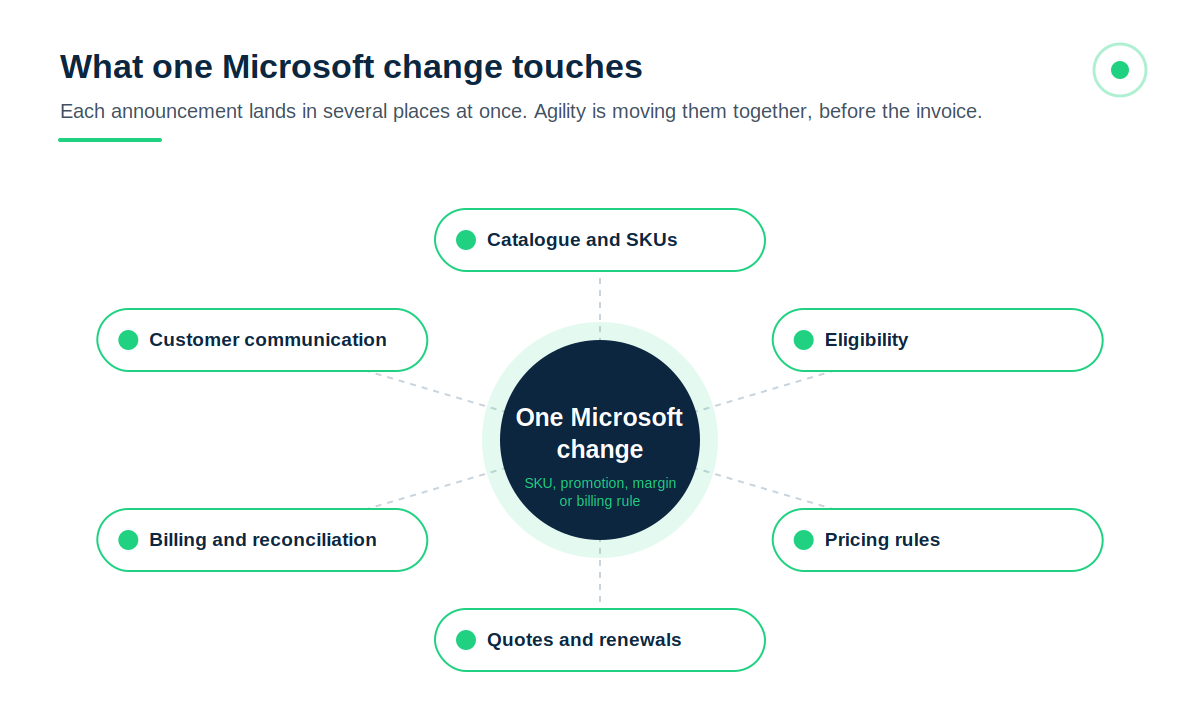
Between 1 July and 30 September 2026, Microsoft published 80 announcements on its Partner Center announcements page. That is roughly six a week. Not all of them matter to a CSP partner's commercial operation, but a steady share do: new SKUs, promotions that start and stop, a new margin model, new APIs, a price uplift, and a new billing default for Copilot. Each one changes what you can sell, what it costs you, or how it reaches your customer's invoice.
No single change on that list is hard. The hard part is the rhythm. Partner systems and the platforms beneath them were mostly built for a world where the commercial rules changed a few times a year. They now move every few weeks. This post looks at what that pace asks of a partner, what agility really means in practice, and why we decided our own platform needed a new foundation to keep up.
How often does Microsoft change the CSP rules?
Often enough that the changes overlap. The table below covers eight months of commercial change that touches how CSP partners quote, price, and bill, from the July price rise through to February 2027. It is a selection, not the full list.
| Date | What changed | What it asks of a partner |
|---|---|---|
| 1 Jul 2026 | Microsoft 365 commercial price increase takes effect | Reprice renewals and decide what to pass on |
| 1 Jul 2026 | Copilot Cowork requires usage-based billing | Set up usage billing for customers using Cowork |
| 1 Jul 2026 | Microsoft 365 Business Standard and Premium with Copilot become permanent SKUs | Add new SKUs to catalogue, quotes, and price lists |
| 1 Aug 2026 | Copilot in 30 trial SKU goes live; MDTI subscriptions end | Manage trial conversions; pass MDTI credit memos on to customers |
| 1 Sep 2026 | Flex spend plan, a new offer construct for consumption, opens in sandbox | Test a new way of buying and billing consumption |
| 3 Sep 2026 | Windows 365 Frontline renamed Windows 365 Flex | Update catalogue names, reports, and scripts |
| 23 Sep 2026 | Growth margin discovery and eligibility APIs move to production | Check eligibility before purchase, not after |
| 30 Sep 2026 | Microsoft 365 E5, E7, and Copilot promotions end | Re-quote open deals that relied on them |
| 1 Oct 2026 | Growth margins go live; 5% uplift on annual-term software billed monthly (existing subscriptions at renewal); 5% margin reduction on selected legacy SKUs | Price each affected subscription deliberately; capture new margin; review legacy exposure |
| 1 Dec 2026 | Usage-based billing on by default for new Copilot Business licences in supported markets (sandbox from 2 Nov) | Explain usage charges and the preset limit to customers |
| 1 Jan 2027 | First annual local currency price update for Commercial Cloud | Plan customer pricing in non-USD markets |
| 1 Feb 2027 | Azure reservation exchanges end for services covered by savings plans | Guide customers between savings plans and reservations |
Read down the right-hand column, and a pattern appears. Hardly any of these changes are "update the price list and move on." Most ask for a decision: what to pass on to customers, what to re-quote, what to explain, what to integrate.
Why does the pace matter more than any single change?
The real cost of change in CSP isn't any one announcement. It's the gap between Microsoft announcing something and a partner being able to quote, buy, price, and bill it correctly. While that gap is open, margin leaks, and people fill it by hand.
Three recent examples show how it plays out.
- The 5% software uplift. From 1 October, annual-term CSP software subscriptions billed monthly carry a 5% cost-of-capital uplift: on new purchases straight away, and on existing subscriptions at renewal. Each affected subscription needs a pricing decision: hold your margin percentage, hold your gross profit, or absorb the cost. If nobody decides, the invoice decides for you.
- Promotions ending. The Microsoft 365 E5, E7, and Copilot promotions ended on 30 September. Any quote built on them in September is a different deal in October.
- Usage billing is enabled by default. From 1 December, new Microsoft 365 Copilot Business licences purchased through CSP in supported markets will use usage-based billing by default, with a preset monthly limit of 4,000 Copilot Credits per user. Microsoft first announced 2 November, which is now the sandbox date. A customer who doesn't know that is one unexpected charge away from a difficult conversation.
None of these needs new technology. All of them need the right information in the right place before the change lands, and they arrive alongside everything else on the list.
What does agility mean for a CSP partner?
Agility gets used loosely, usually to mean speed. For a CSP partner, it means something more specific: the ability to absorb a Microsoft change, determine its commercial implications, and explain them to customers before they appear on their invoice. Most partners are stronger at one of those than the others.
Absorb. New SKUs, promotions, margins, and billing models appear in your catalogue, eligibility checks, pricing, and billing quickly and accurately, without anyone having to rebuild a spreadsheet.
Decide. Each change becomes a deliberate commercial choice, made per customer or per subscription where it matters, rather than something finance discovers at month's end.
Explain. Customers, and your own people, understand the change before it affects them. That matters most for changes customers will notice, like a new usage charge or a promotion that has ended.
Speed helps with all three. But a partner who moves fast and explains nothing still ends up with unhappy customers, and a partner who explains everything but can't bill it correctly still leaks margin.
The question we asked in April applies to us, too.
In April, we wrote about what partners should look for in a CSP platform. One point was about the vendor rather than the features: "There is a significant difference between a platform built on modern, extensible infrastructure and a legacy billing engine with added features. The former can evolve, while the latter often accumulates technical debt that limits future capabilities."
That's a fair question to put to any platform vendor, including us.
Parts of Cloudmore's foundation had been running for years. They worked, but each new capability had to be built around them, which slowed us down just as Microsoft sped up. Niklas Högset, our CTO and co-founder, put it simply in our recent roadmap webinar: the aim is "less time fighting the old platform and more time building what you asked us for."
So we put the largest engineering investment we have ever made into a new foundation. Cloudmore 5.0 replaces several of the core technologies the platform has run on, rebuilds authentication end-to-end, and redesigns the interface around the tasks partners perform every day. New sign-in options include passkeys and app-based multi-factor authentication. Before full rollout, an independent penetration test will check the security work, so partners don't have to take our word for it.
That choice had a cost, and it's worth being straight about it. Engineering time spent on foundations is time not spent on new features. Some of what partners have asked for, support for Microsoft's new growth margins among them, is being built on the new foundation and will arrive later than some partners would like.
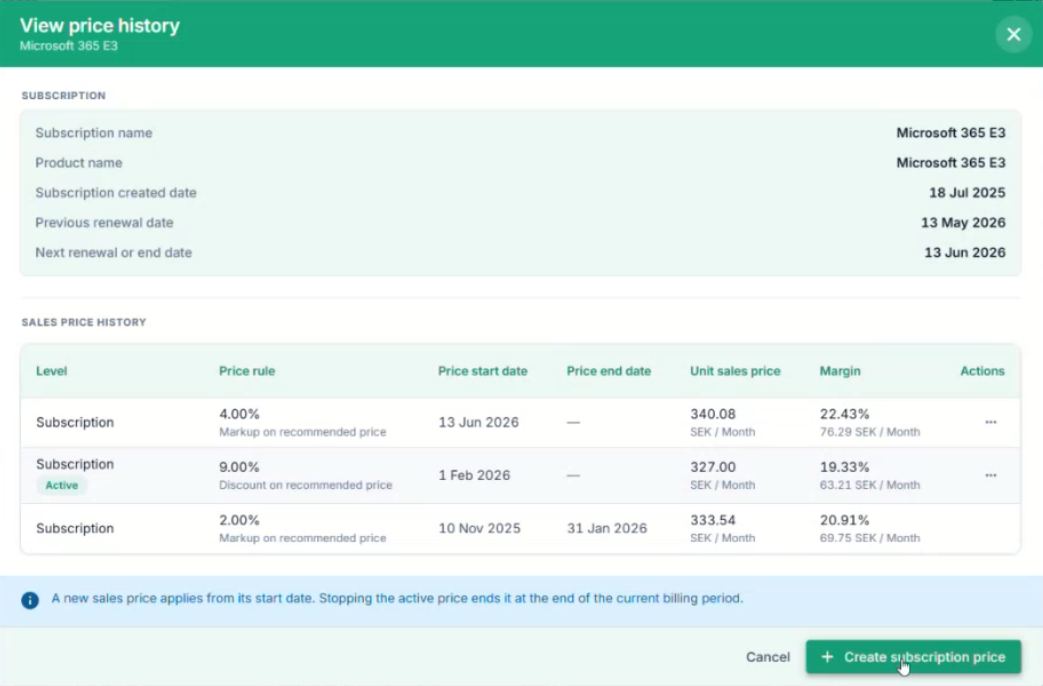
Subscription price history in the 5.0 interface: every price rule, when it applies, and the margin it produces.
A foundation is only worth what gets built on it. Last quarter, while the rebuild was underway, we moved Microsoft promotion-eligibility checks into the order flow, so partners no longer have to check Partner Center separately. Next on the roadmap are growth margin support, price plans for managing pricing across many customers at once, and cost centers for Azure. After that come deeper insights and recommendations across a partner's customer base. Roadmap timing is indicative, and the honest test of 5.0 is whether that list arrives faster than it would have on the old platform.
How do you change a platform without disrupting the people who use it?
A foundation rebuild creates exactly the kind of change this post has been describing, this time for our own partners. We've rolled it out the way we'd like Microsoft to roll out its changes.
- Same platform, same data. Configuration, customers, subscriptions, branding, integrations, and settings all stay where they are. The APIs remain unchanged, and existing logins, MFA, single sign-on, and API credentials continue to work.
- Old and new side by side. The 5.0 beta runs on live data, alongside the current interface, at its own address. Anything done in one shows up in the other straight away.
- Your timeline has a firm end date. Each partner agrees on its own switch date with us, any time up to 31 January 2027. The branded address then points to the new interface, with nothing for the partner to change on their side.
- Words you can reuse. A walkthrough of every changed page, an updated knowledge base, and brandable announcements and short guides that partners can adapt for their own customers.
We're now accepting applications for the beta, and the first partners will join in October. If you're a Cloudmore partner and want an early place, talk to your account manager.
The same principles travel well. When partners roll out Microsoft's changes to their own customers, the questions are the same: what stays stable, who can try the new arrangement first, what the firm date is, and what wording customers will need. The 1 December Copilot Business change is a good place to practise. Tell customers about usage billing and the preset limit before it arrives, help them understand their options, and give their finance teams a short note they can forward.
Frequently asked questions
How many announcements did Microsoft publish for partners in Q3 2026?
Microsoft's Partner Center announcements page lists 80 for July, August, and September 2026: 37, 22, and 21, respectively. They range from programme and skilling updates to pricing, promotions, SKUs, and APIs.
What is Cloudmore 5.0?
A rebuild of the Cloudmore platform's foundation and interface. Core back-end technologies and the authentication system have been replaced, and the interface has been redesigned to focus on everyday tasks. It is the same platform, with the same data and the same APIs.
Do partners need to make any changes to move to Cloudmore 5.0?
No new logins, API changes, or DNS changes are needed. Partners should allow a week or two for their teams to get used to the new navigation, update any of their own manuals or screenshots, and check their branding in the beta.
How can a partner join the Cloudmore 5.0 beta?
Applications are now open through Cloudmore account managers, and the first partners will join in October. Every partner moves across by 31 January 2027, on an individually agreed date.
Sources and further reading
- Partner Center announcements, July 2026, August 2026, September 2026 and October 2026, Microsoft Learn: announcement counts, dates, and details
- Advancing Microsoft 365: new capabilities and pricing update, Microsoft: the 1 July 2026 price increase.
- Microsoft Momentum, September 2026, Dicker Data: the 5% margin reduction on selected legacy SKUs
- Related reading: Copilot Cowork Is Live. For CSP-Managed Customers, So Is a Billing Wall.
- And Microsoft Will Pay You More Margin Starting in October.
Dates and announcement counts taken from Microsoft Partner Center announcements as of 5 October 2026. Cloudmore roadmap items and timings are indicative and may change.
Share this

Eliminating Revenue Leakage in Microsoft CSP Direct Billing
Microsoft Perpetual License Price Management & Billing with Cloudmore