Missed Renewals, Billing Errors, Pricing Gaps: The Three Sources of CSP Revenue Leakage
Revenue leakage is one of the most persistent and least understood challenges in CSP businesses. It is often treated as a financial issue. It appears in margin reports, in reconciliation gaps, or in unexpected revenue shortfalls. By the time it is noticed, it is already embedded in the numbers.
But revenue leakage does not start in finance. It starts much earlier, in how systems, data, and processes interact.
At scale, CSP businesses are no longer simple commercial operations. They are interconnected systems comprising pricing models, billing logic, usage data, customer structures, and multiple platforms. When those components fall out of alignment, even slightly, value begins to leak. Not in obvious, dramatic ways, but gradually and consistently.
The challenge is not that these issues exist. The challenge is that they are rarely visible in isolation.
Across the CSP landscape, three patterns recur.
The first is missed renewals. Subscriptions continue, contracts roll over, and customers remain active, but the commercial moment is lost. Pricing is not revisited, margin is not reassessed, and opportunities to expand or optimize are missed. In most cases, the data exists somewhere in the business, but it is not connected to the right process at the right time. Ownership is unclear, visibility is delayed, and the renewal event becomes administrative rather than strategic.
The second is billing errors. In theory, billing should be deterministic. Usage goes in, invoices come out. In practice, this rarely holds at scale. Adjustments are applied manually, discrepancies are resolved outside the system, and reconciliation becomes an ongoing activity rather than a controlled outcome. Many organizations quietly rely on spreadsheets to finalize billing before issuing invoices. That behavior is not a workaround; it is a signal that the system itself is incomplete.
The third, and most subtle, is pricing gaps. This is where margin erodes without immediate visibility. Legacy pricing persists longer than it should. Cost changes are not reflected in the selling price. Different customers end up on inconsistent pricing structures for similar services. No single issue is material on its own, but over time, these small inconsistencies accumulate into meaningful loss.
.png?width=474&height=300&name=three_sources_v3%20(1).png)
Individually, each of these issues can be explained away. Together, they point to something deeper.
This is not a set of isolated operational failures. It is a systems problem.
In most CSP environments, pricing, billing, usage, and reporting live in different places. Data is fragmented across platforms. Processes are owned by different teams. Visibility is partial and often retrospective. From a systems perspective, revenue leakage is not surprising in this environment. It is a natural outcome of disconnected components trying to operate as a whole.
What is changing, however, is how organizations are responding.
Rather than waiting for a single platform to solve the problem, more advanced teams are building an operational layer on top of their data. They are pulling together information from across their CSP platform, billing systems, ERP, and usage data into a unified view. Tools such as Power BI, internal data platforms, and reporting layers are no longer just for insight. They are becoming central to how the business operates.
Alongside this, the use of internal and organizational apps has accelerated. What was once considered a workaround is now an essential capability. Teams are using Excel and similar tools to quickly and reliably reconcile large datasets. Internal applications built with platforms like Power Apps or Retool are being used to manage workflows that traditional systems do not support. These tools allow teams to process, validate, and act on data at a level of flexibility that most platforms cannot provide on their own.
The introduction of AI into this layer is beginning to further change the speed and depth of analysis. Instead of manually searching for issues, teams can now surface patterns across large datasets in seconds. Billing discrepancies can be identified earlier. Margin anomalies can be flagged before they compound. Renewal risks can be highlighted before the opportunity passes. This is not about replacing systems, but about augmenting how decisions are made within them.
The result is a subtle but important shift. Organizations are moving away from reacting to issues after they occur and towards designing processes that prevent them altogether.
This becomes particularly clear when new customers are onboarded, and their data is analyzed end-to-end. Patterns that were previously hidden begin to emerge. Revenue that has not been invoiced becomes visible. Margins are often lower than expected. Pricing inconsistencies appear across customer segments. Manual adjustments, which were assumed to be normal, reveal underlying structural issues.
These are not edge cases. They are consistent across businesses of different sizes and regions.
The common factor is not the people or the effort involved. It is the system's design.
Real-world customer experiences highlight just how critical these system challenges can be. As the CTO of ITS Nordic, shared: “We began to realize that our overview of the customer was lacking. We couldn’t see what licenses our customers had, and the billing information was lacking. This became increasingly difficult as we moved to cloud services. Dealing with some vendors – to get accurate billing data or to provision services – was problematic.”
Manual billing processes often lead to errors and revenue leakage, as Hampus explains: “We used to have to work out the billing manually. It was laborious, and it resulted in lots of errors… In the long run, we are aiming for everything to be one hundred percent automated and that we can trust the ERP to invoice our customers correctly without us ever having any manual involvement.”
For Brennan IT, the value of automation and transparency was clear. The Software Product Manager, describes: “It used to take us three or four days to issue invoices. But now that Cloudmore is automatically integrated with Microsoft, I just download the report, review it quickly and then send it to our finance team. So with Cloudmore, from start to finish, the whole process only takes about a day—significantly reducing the effort.”
He also shared, “We had to meticulously check where their licenses were being procured from and then manually reconcile them. This was inefficient and meant it could take as long as four days of manual work each month to process the billing.”
These voices from the field underscore that the challenge of revenue leakage is not theoretical—it's a practical, daily reality for CSPs.
What good looks like, therefore, is not perfection. It is alignment.
It is a state where renewals are visible and owned, where billing does not require external correction, where pricing reflects actual cost and strategy, and where data flows cleanly across systems. It is an environment where teams do not rely on heroic effort to maintain control, but on systems designed to support them.
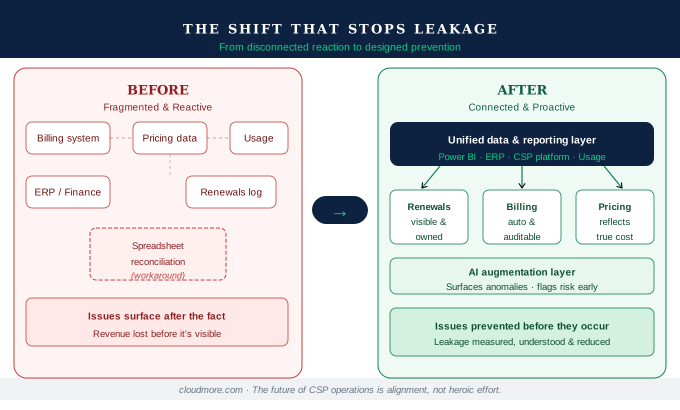
The organizations that are getting this right are not necessarily those with the most tools or the largest teams. They are the ones who understand how their business operates as a system. They connect their data, they define their processes clearly, and they use modern tooling, including AI, to make what was previously invisible visible.
Revenue leakage, in that context, is no longer an inevitability. It becomes something that can be measured, understood, and reduced.
Most CSP businesses are losing revenue today. Not because they are not capable, but because their systems are not designed to show them where.
If you want to understand where revenue leakage may exist in your own operation, there is a practical way to start. Analyzing billing and operational data end-to-end can quickly highlight missed revenue, margin gaps, and process inefficiencies that would otherwise remain hidden.
If that is something you would find valuable, we can help run that analysis with you.
Share this

Revenue Leakage and Margin Erosion in Microsoft CSP Program

Eliminating Revenue Leakage in Microsoft CSP Direct Billing