Every provider gets the request eventually. A customer's finance lead asks whether next month's invoice can be broken down by department. Sometimes it arrives as a spreadsheet that they have been maintaining by hand. Sometimes it arrives as a condition of renewal.
It sounds administrative. It is not. What that finance lead is really asking is whether your billing data is good enough to move money inside their business. If the answer is yes, you become part of how they run their budgets, which is a very difficult position to be displaced from. If the answer is no, you remain a line item on someone else's spreadsheet, and spreadsheets get re-tendered.
This is a guide to the vocabulary, the mechanics, and the parts that break. It is written for providers billing customers, which turns out to be a materially different problem from the one most cost allocation guides describe.
Chargeback, showback, and a word that means two things
Cost allocation is the underlying work: attributing spend to the department, business unit, project, or entity that caused it. Everything else is what you do with the result.
Showback reports allocated cost to a department without moving any money. The department sees what it consumed and what it cost. The spend stays on a central budget, usually IT's.
Chargeback moves the cost. The allocated amount lands on the consuming department's budget and shows up in their P&L. IT stops absorbing it and starts operating as an internal service provider.
Before going further, a warning is worth carrying into customer conversations. In billing and payments systems, "chargeback" usually means something completely different: a reversal, a credit, a refund against an earlier charge. Cloudmore's own billing documentation uses the word in exactly that sense. So when a customer's finance team says "chargeback" and your billing team says "chargeback," there is a real chance they are discussing two unrelated things. Establish which one early.
The difference is commercial, not semantic.
The distinction matters because the two models make very different demands on your data.
Showback changes behavior through awareness. A department sees a number, and the number starts conversations. If the number is roughly right, showback still works. Nobody disputes a report stating that their share of the Microsoft bill was about 11,000.
Chargeback changes behavior through consequence. The number moves real money between real budgets, which means someone owns it, someone signs it off, and someone will eventually challenge it. Chargeback does not tolerate approximation. The first time a department head successfully argues that their allocation is wrong, the entire model loses credibility, and you are back to a central budget and a spreadsheet.
This is why the sequencing advice from the FinOps Foundation is worth repeating to customers: chargeback is not a promotion that showback earns. Plenty of organizations run showback permanently, and are right to do so. If a business does not need departmental P&L allocation of technology spend, chargeback adds argument without adding value. Showback also serves as a useful proving ground, letting everyone check the allocation model against reality before it starts moving money.
| Showback | Chargeback | |
|---|---|---|
| What happens to the money | Stays on a central budget | Moves onto the department's budget |
| Accuracy required | Directionally right is useful | Defensible line by line, or it collapses |
| How does it change behavior | Awareness | Consequence |
| Typical failure | Nobody acts on the report | A department disputes its number, and trust goes |
| What the provider must supply | A credible breakdown | An auditable one, with history |
Why the provider's version is a different problem
Search for cost allocation guidance, and you will find a great deal of it, almost all written for an enterprise allocating its own cloud spend across its own teams. That reader controls the tagging policy, owns the account structure, and answers to their own CFO.
A provider allocating on behalf of a customer has none of those advantages and three specific disadvantages.
You did not generate the data. Your allocation is downstream of vendor reconciliation files that were designed to tell you what you owe, not what your customer's marketing department owes. Whatever granularity the vendor withholds, you cannot invent.
You do not know the org chart. Which cost centers exist, who belongs to which one, and what happens when someone transfers between them are all facts that live inside the customer and change without telling you. Allocation is only as current as the last time someone updated it.
Your output is an invoice, not a report. An internal FinOps team producing the wrong number causes an argument. A provider producing incorrect results in a billing dispute, a credit note, and a conversation about whether the platform is trustworthy. The tolerance differs because the artifact is different.
That third point is the one to hold onto. When a customer asks you for departmental allocation, they are asking you to underwrite it.
Where allocation actually breaks: granularity
The failure is rarely conceptual. Everyone understands the idea of splitting a bill. It breaks on whether the underlying data supports the split at the level being requested.
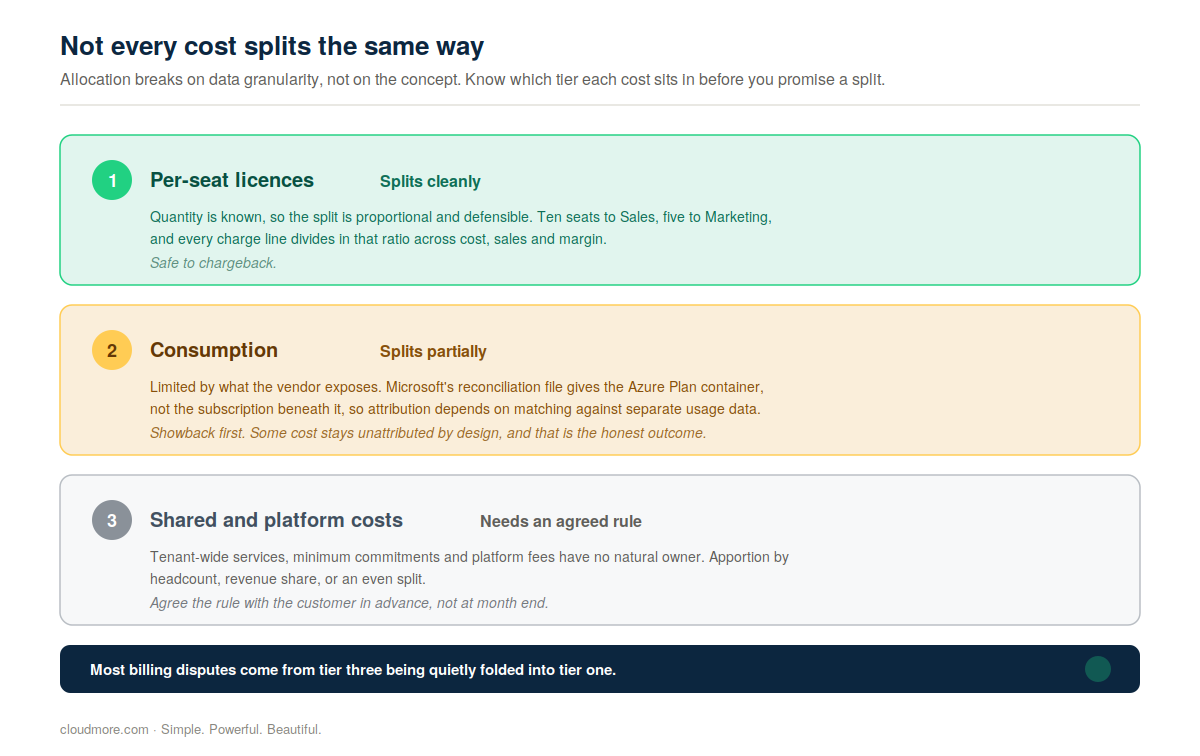
It is useful to think in three tiers.
Per-seat licenses allocate cleanly. A subscription has a quantity, quantities can be divided between cost centers, and the arithmetic is proportional and defensible. Ten seats to Sales, five to Marketing, and every charge line splits in that ratio. This tier is genuinely solved.
Consumption is partially allocated and depends entirely on what the vendor exposes. This is where most allocation projects meet reality. Our own documentation is candid about the mechanism: Microsoft's billing reconciliation file exposes the Azure Plan container rather than the individual subscriptions beneath it, so attributing consumption to the right place means reconciling the billing file against separate usage data, and where the match is not confident, the cost stays at the container level rather than being assigned to a subscription that might be wrong. That is a deliberate choice to be accurate rather than complete, and it is the right one, but it means some consumption arrives unattributed by design.
Shared and platform costs do not allocate at all without a rule. Tenant-wide services, minimum commitments, platform fees, and anything consumed collectively have no natural owner. These need an agreed apportionment rule, headcount, revenue share, or an even split, and the rule needs to be agreed with the customer in advance rather than invented at month's end.
Most disputes trace back to tier three being quietly folded into tier one, or tier two being presented with more precision than the data actually carries.
Then there is timing, which nobody expects.
Allocation is not a single fact. It is a fact with a date on it, and bills contain lines from several different moments.
A month's invoice will typically include a full-cycle charge for the period ahead, prorated charges for licenses added mid-period, and credit lines to reverse changes. Each of those belongs to a different allocation state. The refund for seats that Marketing gave up in December has to go back to Marketing at December's split, not at today's split, or you have quietly moved money between departments while appearing to correct an error.
Handling this properly means keeping a history of allocation states rather than a current setting, and applying charges, prorations, and reversals against the state in force when each line was generated. It is unglamorous, and it is the difference between a model finance will trust and one they will not.
There is a related discipline that catches people out: allocation must occur before billing runs, not after. Once a billing report is generated, the splits behind it are history. Retrospective reallocation is a correction exercise, not a setting change.
Why is this becoming urgent rather than tidy
Cost allocation has been a slow-burning enterprise concern for years. Two things are pushing it up the agenda now.
The first is that the fastest-growing category of Microsoft spend is the hardest one to allocate. Copilot Credits, Cowork task execution, and agent activity all bill on consumption, and consumption is precisely the tier where vendor data granularity is thinnest. We wrote about the mechanics of that shift in our piece on the Copilot Cowork billing wall. The commercial consequence is that customers are about to start asking which department is responsible for a number that moves every month.
The second is that AI spending attracts scrutiny in a way that seat licenses never did. A predictable per-user cost gets renewed without much examination. A variable AI bill gets a question from the board, usually some version of "who is spending this, and on what?" A provider who can answer that is in a strong position. A provider who cannot is exposed, because the easiest way for a nervous finance team to control spend they cannot attribute is to cap it.
That is the commercial argument for taking allocation seriously. It is not an accounting nicety. It is what stops a customer from capping the spend you are trying to grow.
What good looks like
Be honest about which tier each cost sits in. Tell the customer plainly what allocates cleanly, what allocates approximately, and what needs an agreed rule. Providers lose credibility by over-promising precision, not by admitting limits.
Start with showback and say so. Run the allocation for a few cycles as a report before anything moves money. It costs nothing, surfaces arguments early, and lets the customer validate the model while errors are still cheap to fix.
Could you agree on the shared-cost rule in writing before the first bill is issued? Whatever cannot be attributed directly needs a documented apportionment method. Could you agree on it once in advance and stop relitigating it monthly?
Allocate before billing, not after. Make reviewing allocations part of the pre-billing routine. Corrections after the fact are always more expensive than five minutes beforehand.
Could you treat the allocation model as a customer conversation rather than a report setting? Cost centers drift as businesses reorganize. A quarterly review of whether the structure still matches the org chart is genuinely useful within an account, and it is a conversation about their business rather than your invoice.
Where Cloudmore fits
Cost allocation is a core part of what the platform does, and it is worth being precise about what is shipped and what is not.
Cost Centers allow an organization's billing to be split by department, branch, office, or subsidiary. They can be defined by broker users and by the organization's own users, so a customer can maintain their own structure rather than routing every change through you. Subscription licenses are then split across those cost centers, and each billing line is divided proportionally by quantity, cost, sales, and margin, with a cost center column added to the export.
The timing problem described above is handled through snapshots. A new allocation snapshot is recorded whenever a subscription is created, a quantity changes, a renewal changes quantity, or a split is edited, and the most recent snapshot before each billing date drives that period's split. Reversals are treated separately and deliberately: refund lines are apportioned against the historical split they originally came from, so credits return to the cost centers that were charged. In contrast, extra charges follow the most recent allocation. Mid-period changes and prorated amounts are handled accordingly, and every allocation event is logged in the subscription's history.
Now the boundary is stated plainly. Cost center splits in the billing report are currently available in the broker-level export for Microsoft 365 CSP Direct license-based subscriptions. Organization-level billing reports, an in-platform report view, an API, and coverage for Azure consumption, software subscriptions, reserved instances, and custom services are documented as future support rather than available today. In the three-tier framing above, that means we have tier one properly solved and tier two still ahead of us. Extending cost centers to Azure and supporting tag-driven splits are on the 2026 product plan.
Since this article is about trusting numbers enough to move money on them. Reconciliation in this channel is not a solved problem for anyone, and it would be misleading to suggest otherwise. Manual verification against vendor invoices remains common practice among partners, including experienced ones, and there is a reason our documentation is explicit about leaving consumption unattributed rather than guessing. Allocation gets more reliable as the layer beneath it does, and that layer is still improving.
If your customers are starting to ask for departmental breakdowns, the practical first step is to run allocation as showback for license-based subscriptions where the data genuinely supports it, and use that to establish the model and shared-cost rules before consumption enters the picture. Your Cloudmore contact can walk through what that looks like on your own base, including where the current limits sit.
Unfortunately, the customer asking you to split their invoice is not making an administrative request. They are asking whether you can be part of how their business allocates money. Providers who can answer that carefully, including about the parts that do not yet work, end up embedded in a way that price alone never achieves.
Sources and further reading
- FinOps Foundation: chargeback and finance integration guidance, including the position that showback is a legitimate permanent model rather than an incomplete one
- Cost Centers, Cloudmore Knowledge Base: snapshot logic, proportional splitting, and current scope
- Azure Billing Settings, Cloudmore Knowledge Base: why Azure Plan container data limits consumption attribution
- Related reading: Copilot Cowork Is Live. For CSP-Managed Customers, So Is a Billing Wall. Most customers now prefer minimal direct interaction with providers.
Platform behavior reflects the Cloudmore Knowledge Base at the time of writing, and roadmap items are identified as such. Cost allocation terminology follows FinOps Foundation usage.
Share this

Eliminating Revenue Leakage in Microsoft CSP Direct Billing

Master Consumption Billing as a Microsoft CSP Partner